When Should OEMs Specify a Wiring Loom Instead of Separate Cable Assemblies?
As electrical systems become more complex, separate cable assemblies can become harder for OEM teams...
Read More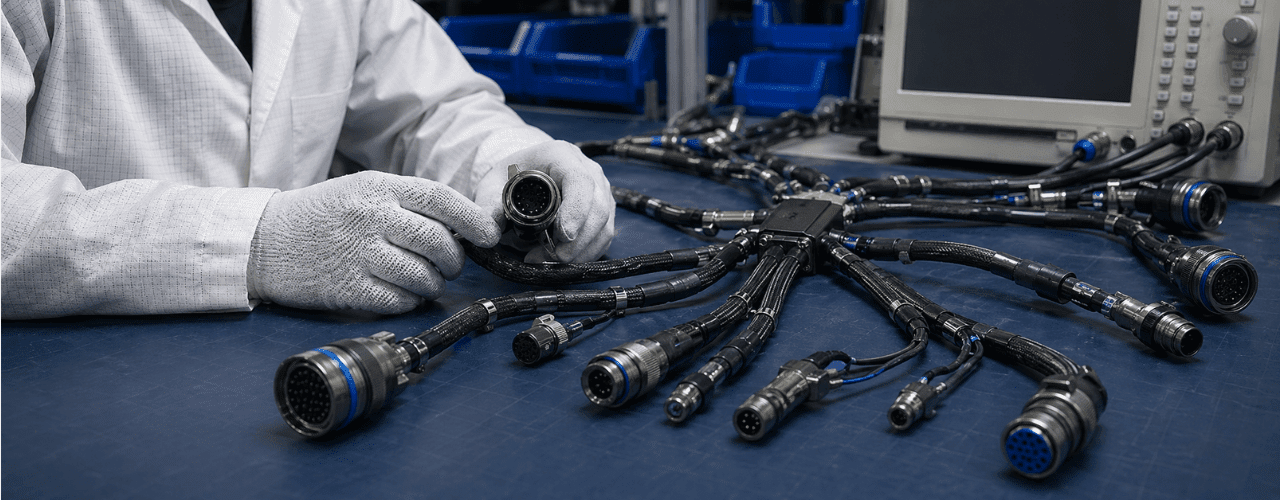
In defence and aerospace procurement, the label on the parts list does not tell the full story. A cable assembly can use mil-spec components and still fall short of the process control, documentation, testing and traceability expected by the specification, contract, customer or application.
When buyers assume that approved parts automatically produce a compliant assembly, they leave room for risk that may not appear until inspection, qualification or service. In high-consequence environments, that is too late.
For procurement and quality teams in defence and aerospace, the question is straightforward. Can the supplier control the full build, support traceability and provide the documentation and test evidence needed for approval for mil-spec cable assemblies?
Suppliers and buyers often use the term “mil-spec” too loosely.
In some cases, it refers to the components alone. The connector may meet a military specification. The wire may meet a military specification. That still does not confirm that the finished cable assembly meets the level of control a defence or aerospace programme expects.
A genuine mil-spec cable assembly depends as much on the build process as it does on the parts themselves. Near-spec builds usually show where things start to fall short. They can look right on paper, include recognised components and perform adequately in a lighter commercial setting, but still lack the process control, traceability, documentation and audit readiness that critical programmes demand.
For procurement teams and engineers, that distinction affects acceptance, field reliability and programme risk. That is why many buyers look beyond component claims and focus on manufacturers that can control the full assembly process and support the work through bespoke cable assemblies.
The simplest way to understand the issue is to separate material compliance from assembly compliance.
Material compliance means the parts used in the build meet relevant requirements. That is important, but it is only one layer of the picture.
In practice, a compliant assembly usually means the manufacturer builds the finished product under controlled conditions using defined methods. The build should follow qualified workmanship standards, include traceable materials, and generate recorded test results and the right documentation pack.
A supplier can buy good parts from approved sources. That does not prove the team controlled crimp height or met the required workmanship standard in soldering. It does not confirm the team used the correct tooling and settings at each stage of the build. It also does not prove the team handled stripping methods, routing, identification, strain relief, sealing or environmental protection correctly. Nor does it prove the assembly can stand up to first article review, customer inspection or later audit if a prime contractor asks for evidence.
That is why buyers should treat claims about approved components with caution. Good materials matter. They do not remove the need for disciplined manufacture.
Control is what defines a genuine mil-spec cable assembly.
The build should follow documented instructions and approved methods, with workmanship controlled to a repeatable standard. That helps reduce variation between assemblies and gives buyers more confidence in what they are approving. The team also needs to know exactly which standard it must follow and apply it consistently.
Workmanship matters because small assembly errors can create large downstream failures. Poor termination quality, weak strain relief, contamination or inconsistent routing may not always show up in a basic visual check. In harsher environments, those issues can shorten service life or cause early failure.
The production setting also matters. For defence, aerospace and other high-reliability applications, the environment should support control and repeatability, with the right level of cleanliness for the job. That helps protect consistency across batches and reduces the chance of problems appearing later in inspection or service.
A compliant result comes from the way the assembly is built, not from the bill of materials alone.
In practice, buyers may expect a supplier to provide records such as a certificate of conformity, build pack or drawing revision history, lot or batch traceability, inspection records and test records. Where the programme requires it, the supplier may also include first article support in that package.
The exact requirement depends on the assembly specification, the contract, the customer requirement and the application. There is no single universal checklist that covers every mil-spec cable assembly.
A compliant assembly should not force the customer to guess where parts came from or how the team controlled the build. The supplier should already hold that evidence, together with a clear record of the checks completed during manufacture.
Weak traceability creates problems quickly. A later non-conformance becomes harder to contain. Customer questions take longer to answer. Audit scrutiny becomes harder to manage.
For genuine mil-spec cable assemblies, documentation does not begin at the end of the job. It sits inside the manufacturing control system from materials receipt and revision control through to inspection sign-off and release records.
A near-spec build may pass a simple continuity check and still fall short of the demands of the application. In defence and aerospace, buyers need confidence that the assembly has been tested in a way that reflects the technical and environmental demands of the job.
The exact test plan depends on the programme, but the logic stays the same. Testing should verify performance, not create a false sense of assurance in mil-spec cable assemblies.
That can include continuity, insulation resistance, high-potential testing where required, dimensional inspection and visual inspection against defined workmanship criteria. Depending on the application, the test plan may also extend to vibration, temperature exposure, mechanical durability, sealing integrity or other operating conditions.
A supplier that claims compliance should be able to explain:
For procurement and supplier quality teams, incoming inspection is the wrong stage to discover that a supplier has taken a light-touch approach to verification.
The commercial risk of a near-spec build goes well beyond product failure.
If an assembly cannot satisfy documentation or traceability requirements, an incoming inspection or quality review may reject it. That can delay production schedules and create avoidable rework. If teams discover the issue later, the cost rises.
In defence and aerospace programmes, delays rarely stay isolated. A single questionable assembly can affect system integration, hold up qualification activity, and damage customer confidence or supplier standing.
There is also the technical risk. A cable assembly that appears acceptable in a controlled commercial setting may not hold up in harsher service conditions. Exposure to vibration, temperature shifts, moisture, movement or EMI-related demands can expose weaknesses that a lighter-duty build would not survive.
The result can be expensive. Rework carries cost. So do replacement, investigation, requalification and wider supplier review. Lost trust adds another layer.
That is how a cheaper option at order stage can turn into a more expensive problem later.
If your application depends on genuine compliance, not broad claims, assess a supplier’s process control, documentation depth and testing discipline before release. It is far easier to resolve those questions early than after incoming inspection, qualification activity or customer review exposes problems at a higher cost.
If you need a clearer view of what a compliant build should include, speak to GEM Cable about documentation, traceability and testing support for mil-spec cable assemblies.
Procurement teams do not need to rely on labels alone when they review mil-spec cable assemblies. Start with process control. Ask how assemblies are built and released, where inspection sits inside that process, and whether the supplier works to controlled build packs, approved instructions and clear inspection hold points.
Then move to documentation. Ask what records the supplier provides, how it maintains traceability, what controls it applies around revision changes, and what evidence it retains if a customer asks for a full history of the assembly. If the answers stay vague, that should raise concern.
Testing comes next. Ask which inspection and test stages apply, which pass and fail criteria the supplier uses, how it logs results, and what it does when an assembly fails a check or shows a recurring defect pattern.
A practical supplier review should answer five questions:
If you need a compliant mil-spec cable assembly manufacturer, look for a supplier that can show control clearly, answer technical questions directly and produce records without delay.
For defence, aerospace and other high-reliability applications, approved parts are only one part of the picture. Mil-spec cable assemblies also need controlled manufacture, disciplined assembly methods and documentation that can stand up to review.
GEM Cable helps buyers reduce that risk by combining controlled manufacture, traceability, documentation control and testing support from the start of the build, not as a later add-on for bespoke cable assemblies.
That approach fits how GEM Cable handles complex cable and harness work across defence and aerospace applications. It helps buyers move forward with more confidence and fewer late-stage documentation or verification issues.
If you need mil-spec cable assemblies backed by disciplined manufacturing, traceability and documented quality control, GEM Cable can help you assess the requirement early, reduce supplier approval risk and define a compliant build before issues surface later in the programme.
Ready to talk cables, fibre or full network solutions? Get in touch with our team today, we’re here to help.