Why 100% Testing Matters When Comparing Cable Assembly Manufacturers
A wiring error is easiest to deal with before a cable assembly leaves our factory....
Read More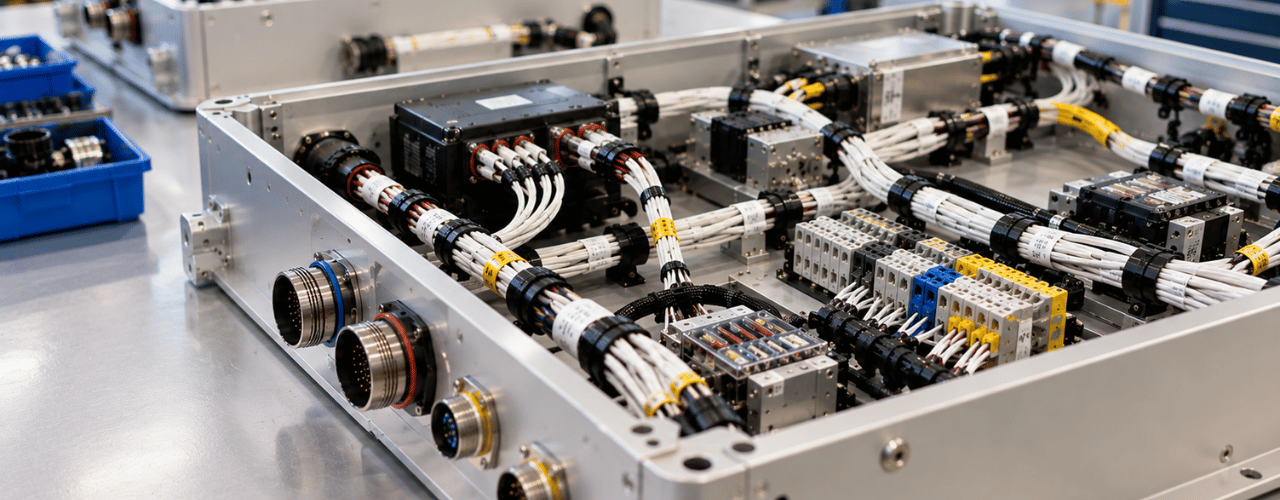
OEMs may decide to outsource a complete build when several practical pressures begin to overlap. Cable assemblies may come from one supplier, enclosure or panel work from another, while the OEM’s own team manages wiring, revisions and final integration. That arrangement can work well until the handoffs begin to absorb more engineering, procurement and production time than they should. The question then becomes whether some of that connected work can move to one manufacturer without giving up control of the drawings, interfaces and acceptance requirements.
Outsourcing is worth considering when the OEM is repeatedly coordinating work that ultimately has to come together in the same unit. At GEM Cable, that can mean bringing the relevant cable assemblies, harnesses, mounted wiring and box build assembly work together within one agreed UK manufacturing package, subject to the requirements of the project.
The starting point is to decide what GEM will manufacture, what we may source where agreed, what the customer will supply and what should remain with the OEM. That division needs to reflect the current design, interfaces and inspection requirements, with approved manufacturing information agreed before production. Once those boundaries are clear, the OEM can judge whether consolidation will genuinely simplify the build.
A box build assembly can mean different things depending on the product and the manufacturer. For an OEM, the useful question is not where the definition starts or ends. It is which parts of the current build can sensibly be completed together before the unit comes back into the wider system.
In the GEM Cable context, that can include specified cable assemblies, wiring looms or harnesses, connectors, mounted wiring, control boxes, panels and associated enclosure work. The package is agreed around the current design and, before production, the approved manufacturing information, supplied components, interfaces and inspection requirements. This distinction matters because some electronics manufacturers use ‘box build’ for much broader services, including PCB assembly or firmware loading. Those activities should not be assumed to form part of GEM’s work unless they are specifically confirmed.
Outsourcing is worth reviewing when managing the interfaces between suppliers and internal assembly is taking increasing effort, particularly once the same integrated unit needs to be built repeatedly.
A multi-supplier model requires somebody to keep the interfaces aligned. Drawings need to match, changes need to reach the right people, and the harness still has to fit and connect correctly when the enclosure or panel arrives. If one manufacturer can make the harness and complete the relevant panel or enclosure work, one of those handoffs can disappear.
Keeping final assembly in-house can be the right choice when it gives the OEM useful control or flexibility. The balance changes when internal teams are repeatedly fitting harnesses, resolving the same interface questions or checking the same details on every build. At that point, it is worth separating the work the OEM genuinely needs to retain from the work that could be completed earlier by a manufacturing partner.
A working prototype does not necessarily give a manufacturer everything needed to build the same unit again. Once another unit is required, revision status, wiring information, identification and acceptance criteria need to be explicit. Repeat box build manufacturing depends on those details being captured in approved build information instead of relying on what somebody remembers from the first unit.
A practical opportunity for consolidation exists where several manufacturing activities already form part of the same integrated unit. If a harness needs to be installed into a panel, control box or enclosure before final integration, combining those activities can remove one supplier handoff.
At GEM Cable, we can bring relevant bespoke cable assemblies, wiring looms and harness manufacture together with control panels, control boxes, cabinets, enclosures and box builds where the project requires it. Our Welwyn Garden City facility is dedicated to cabinet and box-build projects, and our published capability covers prototyping, procurement, build and final test.
Not every component or manufacturing step needs to move with the build. GEM may manufacture some items and source others where agreed, while specialist electronics, proprietary modules or other work outside our confirmed capability may remain with the OEM or another approved supplier. Setting those responsibilities early helps reduce ambiguity later in the build.
A useful box build RFQ gives the manufacturer enough information to understand what is being quoted and how the parts are expected to fit, connect and be accepted. The same information then becomes the basis for agreeing the production requirement.
A bill of materials may be part of the build information where relevant. The more important point is that both parties can identify the current revision, know who is authorised to approve a change and understand how that change reaches production.
If you already have drawings, wiring information or an existing build specification, our technical team can review what is available and identify what else may be needed before the manufacturing package is agreed.
Repeat builds depend on everyone working from the same approved information. Drawings, wiring data, component requirements and identification should all refer to the same revision. If something changes, the next unit should not be built from an older instruction or an informal update. This is why revision control matters: it keeps the physical build aligned with the information the OEM has approved.
Testing should reflect the product and its acceptance requirements. Cable or harness elements may need electrical checks, while the integrated build may also require dimensional, visual, connection or other project-specific verification. Agreeing those checks before manufacture means both teams know what will be inspected and what a passing build looks like.
GEM’s published box-build capability includes final test. The specific inspection and test requirements should still be agreed for the individual project. One bespoke box build assembly may need different checks from another because the design and customer specification are different.
Some projects are better served by keeping part of the integration in-house. The question is whether moving the work outside creates a clearer manufacturing arrangement or simply shifts complexity from one place to another.
Partial outsourcing is a valid outcome. The aim is to remove avoidable handoffs, not to move the maximum amount of work outside the OEM. Keeping a specialist process in-house can still make sense if the rest of the build is easier to manage.
A UK box build supplier should be judged on the work the OEM actually wants it to perform, not on the length of its service list. Procurement and engineering teams can use a few practical questions to compare what different manufacturers can support.
GEM Cable operates two UK manufacturing facilities, including a Welwyn Garden City site dedicated to cabinet and box-build projects. Our cabinet and box-build capability operates within GEM Cable’s AS9100D and BS EN ISO 9001:2015-certified quality management system, with IPC/WHMA-A-620-trained personnel supporting controlled manufacture. Our published capability covers prototyping, procurement, build and final test, alongside cable assemblies, wiring looms and control panels that can form part of the same project. An OEM looking for a cable harness and box build manufacturer can therefore discuss the cable and wiring work alongside the cabinet or box-build requirement, without assuming the broader services of a general electronics contract manufacturer.
If your team is spending increasing effort coordinating cable, harness, panel and enclosure work, it may be worth asking whether some of those activities can be completed together. Start with the drawings, wiring requirements, interfaces and acceptance criteria you already have. From there, GEM Cable can review what needs to be manufactured, identify the elements we can support and confirm which requirements sit outside the agreed package.
Discuss your box build requirements with our technical team.
Ready to talk cables, fibre or full network solutions? Get in touch with our team today, we’re here to help.