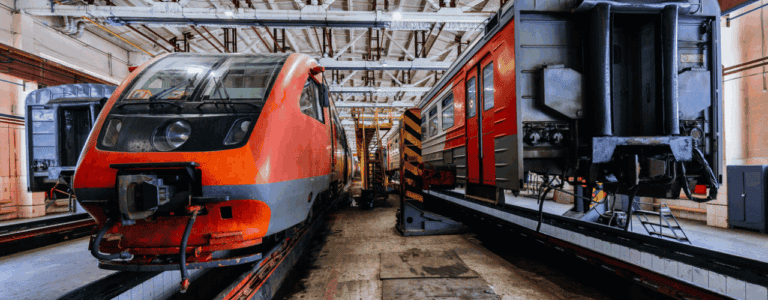
How Can a Rail Cable Assembly Manufacturer Support Depot Automation?
Automated rail depot equipment can require cable assemblies built around specific interfaces, routing and testing...
Read More
As electrical systems become more complex, separate cable assemblies can become harder for OEM teams to route, identify and reproduce consistently. Where multiple connections share defined routes, branch at fixed points and terminate at specific connectors, a bespoke wiring loom can bring those requirements into one controlled assembly. The right choice depends on the equipment layout, how the connections are installed and how independently they need to be maintained or replaced.
At GEM Cable, we manufacture bespoke wiring looms, cable harnesses and custom cable assemblies in the UK. Working from customer-approved requirements, we can manufacture assemblies around defined routing, branch dimensions, connector references, identification and agreed testing requirements. This allows related electrical connections to be supplied as a controlled assembly where a wiring loom is appropriate, rather than leaving multiple individual cables to be organised during equipment build.
A wiring loom becomes worth considering when separate cable assemblies start creating unnecessary complexity in routing, identification, installation or repeat production. Separate cable assemblies can still be the right choice when connections are independent, easy to identify and straightforward to route.
A wiring loom may be worth considering when several of the following issues start appearing:
None of these points creates an automatic requirement for a loom. Together, however, they can indicate that the electrical connections are better treated as one coordinated assembly rather than a collection of separate parts. This is a useful point to raise with wiring loom manufacturers before quotation.
If these issues are appearing in your build, we can manufacture a bespoke wiring loom around your approved drawing and connection requirements, bringing related routes, branches and connectors into one controlled assembly where that format suits the application.
If you need to clarify the terminology before making that decision, our guide to cable assemblies, harnesses and wiring looms explains the distinctions.
A wiring loom can simplify OEM assembly by bringing related cables, branches and connectors into one defined assembly that can support consistent repeat manufacture. Instead of managing several independent assemblies, you can define how related connections should be arranged as one build.
This can be particularly useful where the installation has fixed connection points or where the same routing needs to be repeated across multiple units. A well-defined loom can give your production team a clearer reference for where branches should sit, which connector belongs at each end and how the assembly should be identified.
For buyers comparing wiring loom manufacturers, this is less about adding technical complexity and more about reducing ambiguity. A well-defined loom can bring related requirements into one controlled item, which may simplify purchasing, drawing control, assembly identification and repeat manufacture.
The important point is that the value comes from the specification. A loom does not automatically mean lower cost, faster installation or better performance. It becomes useful when the agreed layout supports the way the equipment is built, installed and maintained.
Before approaching wiring loom manufacturers, OEM engineering and procurement teams should assess routing, branch positions, connector locations, identification requirements, service access and how the equipment will be assembled.
The first question is routing. If several connections need to travel together and separate assemblies are repeatedly being positioned in the same way, combining them may make the build easier to define. If the routes are genuinely independent, keeping them separate may still be more practical.
The second question is branch and connector location. Where several branches need to reach fixed points, a loom allows those positions to be specified as part of one assembly. This can be useful for repeat builds because the required branch arrangement is defined in advance rather than decided during installation.
Identification also matters. As the number of connections grows, clear labels and connector references become more important for production, inspection and maintenance. Bringing related connections into one loom can make that identification easier to manage, provided the requirements are defined clearly.
Finally, consider access. A loom should support the way the equipment is assembled and serviced. If combining connections would make a frequently replaced module harder to remove, separate assemblies may remain the better choice.
Final equipment layout, installation routing and design approval remain with the customer or authorised design authority.
Separate cable assemblies may be more suitable when connections follow independent routes, equipment modules need individual replacement or the system layout is still changing. They can also give you more flexibility where smaller assemblies are easier to install or manage separately. Keep this distinction clear when comparing wiring loom manufacturers.
When you compare wiring loom manufacturers, look for a partner that can work from the application requirement and approved build information, with the assembly format determined by the project.
Wiring loom manufacturers typically need an approved drawing or specification, connector details, branch dimensions, identification requirements, quantities and any agreed testing requirements. At GEM Cable, the exact information we need will depend on the project.
A useful starting point is:
The aim is not to create unnecessary documentation. It is to remove ambiguity before manufacture starts. Clear information gives wiring loom manufacturers a stronger basis for quotation and gives you a better basis for comparing scope.
For more detail on build information, identification and installation readiness, see how cable harness manufacturers can reduce installation delays.
At GEM Cable, we manufacture bespoke wiring looms, cable harnesses and custom cable assemblies in the UK around customer-approved requirements. Our UK manufacturing is supported by an AS9100D and BS EN ISO 9001:2015-certified quality management system. We also manufacture within a Class 8 cleanroom environment, with every product undergoing 100% testing on our Banair testing system. This allows you to discuss the assembly format that suits the equipment, subject to the approved specification and our confirmed manufacturing scope. If you are comparing wiring loom manufacturers, our focus is to manufacture against agreed requirements within our confirmed scope.
We can work with build information covering dimensions, connector requirements, identification and agreed testing requirements where these form part of the specification. If your project also includes related connector, fibre, panel, box or enclosure requirements, these can be discussed with us as part of the wider cable and connectivity package. Our robotics sector is one example where tailored wire looms, harnesses and cable assemblies support complex automation applications.
Your procurement team gets a practical route from a defined requirement to quotation and manufacture, while your engineering team can keep the discussion focused on the approved design, the required assembly format and the information needed to build it consistently. That also gives you a clearer basis for comparing wiring loom manufacturers against the same project requirements.
When you ask wiring loom manufacturers for a quote, send your latest drawing or specification together with the connector, routing, quantity and relevant testing requirements you already have. This gives us a clear starting point for reviewing the requirement and identifying any information still needed before quotation.
At GEM Cable, we can review the information you have and confirm what else may be needed before manufacture, so you do not need to wait until every detail is finalised before starting the conversation. This also helps you compare wiring loom manufacturers against the same defined requirement.
Send us your specification or discuss your wiring loom requirements with our technical team.
Ready to talk cables, fibre or full network solutions? Get in touch with our team today, we’re here to help.